
Websites for health and therapy practices in Brisbane
A health practice website has two jobs at once: help someone who's ready to book find the right practitioner, fees and times, and say all of it within the advertising rules your profession works under. We build them for allied health and therapy practices, counsellors, NDIS providers and small clinics across greater Brisbane: a page for each service, your qualifications stated exactly, fees and booking in plain sight, and a page for each location.
A practice website with us costs $2,500 to $4,000 and takes 2 to 4 weeks for most practices. After launch, the $79/month care plan keeps it hosted, secure and up to date, with small changes included.
- Investment
- $2,500 - $4,000
- Timeline
- 2-4 weeks
- Maintenance
- $79/month
What goes into a practice website
Who you are, in your registration's exact words
Your qualifications, your registration or membership body and the title you're allowed to use, written the way the register or your association states them. A title that doesn't match the register is an easy mistake to make and a hard one to explain.
A page for each service
Physio for back pain, couples counselling, NDIS therapy supports: each gets a page on what it is, who it's for and what a first session looks like, without promising results.
Fees before the booking button
What a session costs, how long it runs, the cancellation policy, and whether Medicare, private health insurance, WorkCover or NDIS funding applies.
Booking through the software you already use
The site links to the booking page of Cliniko, Halaxy, Zanda or whatever you use, so patient records never touch the website.
A page for each location
The address, the days you're there, a map, parking and public transport. Each room you work from gets its own page.
Forms that don't ask for health details
The contact form asks only what you need to reply, sends it to your inbox and keeps no copy on the website. The privacy policy says in plain words what happens to a message.
How much does a website for a health practice cost?
With us, $2,500 to $4,000. Where it lands depends mostly on how many services, practitioners and locations get a page, and whether the site is in one language or two. A sole practitioner with four services and one room sits near $2,500. A practice with several practitioners, a dozen services and two locations sits near $4,000. The website cost guide compares that with what DIY builders, freelancers and agencies charge.
Hosting, SSL, updates, backups and small changes are $79 a month on the care plan, with 2 hours of changes each month included. A booking system of your own, with its own payments or a client portal, is custom software, from $3,000.
What can a health practice website say under AHPRA's advertising rules?
If you're a registered health practitioner (physiotherapists, psychologists, occupational therapists, chiropractors, osteopaths, podiatrists, dentists, doctors, nurses and the other professions on AHPRA's register), your website is advertising, and section 133 of the National Law applies to it. In short, it can't be false or misleading, can't use testimonials about clinical care, can't offer a gift or discount without stating the terms, can't create an unreasonable expectation that treatment will help, and can't encourage people to use services they don't need.
That shapes the build. No patient reviews or stories about treatment on the site, including Google reviews pulled in through a widget. No "specialist" unless you hold specialist registration, and only the titles your registration allows. No before-and-after photos that promise a result, and no claim that a treatment works unless acceptable evidence backs it. AHPRA publishes its advertising guidelines and resources for checking your own advertising. What's here is how we build, not legal advice: when in doubt, your board or professional association has the final word.
What if my profession isn't registered with AHPRA?
Plenty of health professions aren't. Counsellors, psychotherapists, dietitians, exercise physiologists, speech pathologists and massage therapists are self-regulated through a professional association. The rules are different, not absent: your association's code of ethics usually covers advertising, the Australian Consumer Law applies to every business, and in Queensland the Health Ombudsman oversees a code of conduct for health workers who aren't registered.
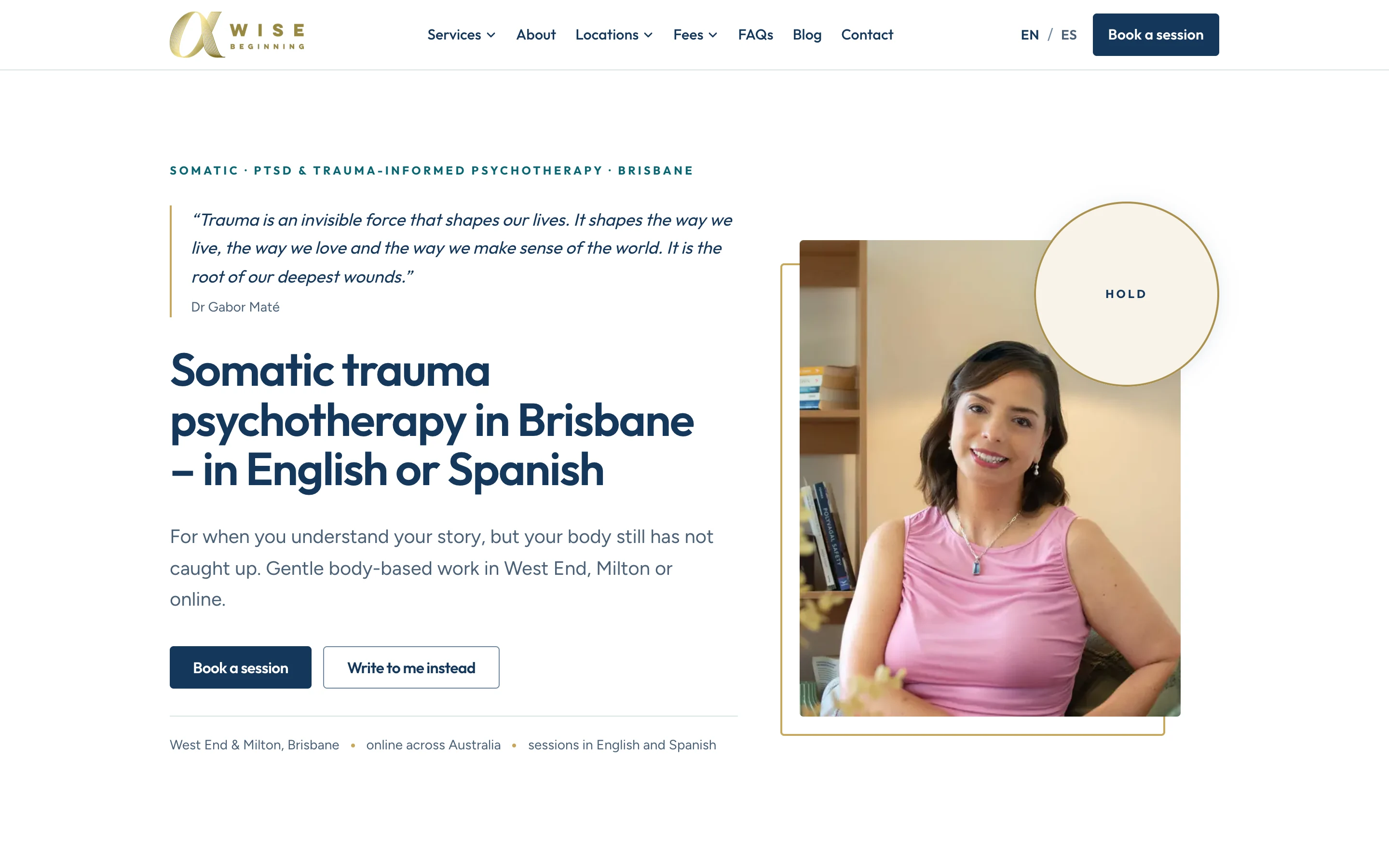
Wise Beginning is a good example. Alpha Ponce is a PACFA Registered Clinical Counsellor and Somatic Psychotherapist, and the site uses those exact words. Her pages say plainly that her sessions carry no Medicare rebate, and there are no testimonials anywhere on the site. We hold every practice site to that standard, registered or not: accurate titles, no promised outcomes, fees in plain sight.
NDIS providers have one more layer. Registered and unregistered providers both work under the NDIS Code of Conduct, and only registered providers should call themselves registered. An unregistered provider's site can still say clearly that it works with self-managed and plan-managed participants, which is what those participants look for.
Should the website take bookings, or link to my practice software?
Link to it, almost always. Cliniko, Halaxy, Zanda, Power Diary and Nookal already hold your calendar, your reminders and your patient records. The website's job is to get someone to that booking page ready to book: they've seen the fees, the cancellation policy and which location suits them.
That's how Wise Beginning works. Alpha asked that anyone who presses "Book" sees the fees and cancellation policy first, so every booking button on the site leads to the fees and booking page, and from there one button opens her Zanda client portal. A booking system of your own only makes sense when the practice software can't do something you need, like group programs with payments, and that's custom software.
How should a health practice website handle privacy?
Carefully, because anything a person types about their health is sensitive information under the Privacy Act. The forms we build for practices ask for a name, a way to reply and a short message, send it straight to your inbox and keep no copy on the website. If the site uses analytics that set cookies, they load only after consent.
On Wise Beginning the form sends an email and stores nothing, and the privacy page asks people not to send detailed clinical information through it: a sentence about what brings them is enough.
Does each location need its own page?
Yes, if you see people there. Someone choosing between two rooms wants the address, the days you're in, parking and the nearest bus stop, and Google wants a page it can match to each Google Business Profile.
Wise Beginning has two: West End on Tuesdays and Thursdays, Milton on Wednesdays, plus sessions online. Each has its own page with its hours and a map. The hours live in one place in the code, so the location page, the footer and the structured data Google reads can't disagree. Keeping the Google profiles themselves in shape is ongoing work, and it's what our local SEO service does.
How long does it take, and what do you need from me?
2 to 4 weeks from the first call to launch for most practices. Bigger sites take longer: Wise Beginning, with 42 pages in English and Spanish, took about eight weeks from kickoff to launch. What slows a project down is almost always content, so it helps to have your services, fees, cancellation policy, registration details and locations ready, plus a photo of yourself you actually like.
You review every page before it goes live. If you already have a site, we redirect the old pages to the new ones, so the Google traffic it earned doesn't vanish on launch day. Wise Beginning had 57 old WordPress addresses, and every one of them now lands on a live page.
A practice website we've built
When a practice website isn't what you need
- You're fully booked from GP referrals and word of mouth, and don't want more enquiries. A tidy Google Business Profile and your directory listings are enough for now.
- You want patient testimonials or before-and-after results front and centre. If you're registered with AHPRA, we won't build that: it breaks the rules your registration depends on.
- You need clinical notes, invoicing or telehealth. That's your practice software's job, and the website links to it.
Questions people ask
How much does a website for a health practice cost?
With us, $2,500 to $4,000, depending on how many services, practitioners and locations get a page, plus $79 a month for hosting, updates and small changes. The cost guide compares that with DIY builders, freelancers and agencies.
Can I put patient reviews on my practice website?
If you're registered with AHPRA, not reviews about clinical care: the National Law bans testimonials in advertising, and your website is advertising. Comments about non-clinical things, like parking or a friendly front desk, are allowed. You aren't responsible for reviews people leave on Google, but pulling them onto your own site makes them your advertising. If you aren't registered, check your association's code first.
Can I use "specialist" or "Dr" on my website?
"Specialist" only if you hold specialist registration in that field. A practitioner with a doctorate who isn't a medical practitioner can use "Dr" if the site makes the profession clear next to it. Protected titles like psychologist or physiotherapist belong to registered practitioners only.
Can the website connect to Cliniko, Halaxy or Zanda?
Yes. The booking buttons link to your practice software's own booking page, so appointments, reminders and patient records stay in the system you already use. Wise Beginning's site works this way with Zanda.
Do NDIS providers need a website?
Participants and support coordinators usually look a provider up first. A site shows the supports you deliver, the areas you cover and which participants you can work with: self-managed, plan-managed or NDIA-managed. Only registered providers should describe themselves as registered.
Is a contact form safe for patient privacy?
It is when it asks for the minimum: a name, a way to reply and a short message, sent to your inbox with no copy kept on the website, plus a line asking people to leave clinical details for the session.
Can my practice website be in two languages?
Yes. Wise Beginning's site runs every page in English and Spanish, so someone searching in Spanish lands on a Spanish page. A second language adds to the cost, because every page is written twice.
Do you build practice websites outside Brisbane?
Yes. We work across greater Brisbane and South East Queensland, from the Sunshine Coast to the Gold Coast, and most of a project runs over video calls and messages.
Want a practice website that gets the details right?
Book a 20-minute call. Tell us your profession, your services and where you see people, and we'll come back with a written proposal: scope, cost and launch date. We reply within 24 hours.
Book a 20 min chatNot a health practice? See web design in Brisbane for other small businesses, or what the care plan covers after launch.